
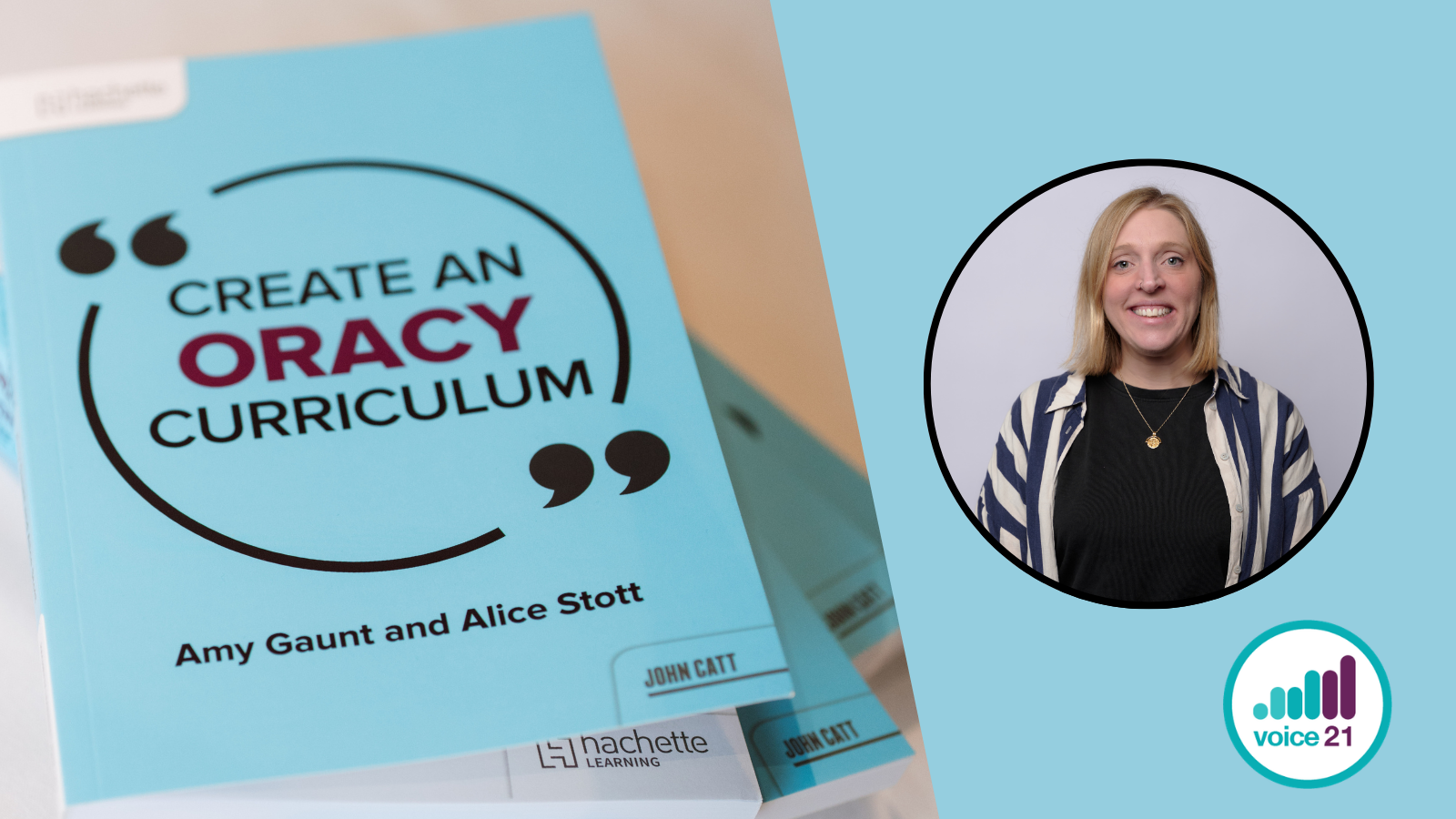
Drawing on Create an Oracy Curriculum, her new book co-authored with Alice Stott, Voice 21’s Amy Gaunt explores what it takes to make oracy a lasting part of every student’s education.
The Secretary of State for Education’s commitment to “hardwire” oracy into the national curriculum is a welcome recognition of the important role schools play in developing children’s speaking, listening and communication skills.
The revised national curriculum should provide welcome guidance on what aspects of oracy should be taught. But schools will still need to think carefully about what an oracy entitlement looks like for their students: what they want them to learn, how that learning builds over time, and where they will have opportunities to put their skills into practice.
These are questions that Alice Stott and I explore in our new book, Create an Oracy Curriculum, drawing on our work with schools and colleges across the Voice 21 network.
A curriculum-led approach makes oracy part of how we do things here: planned for, explicitly taught and developed throughout a child’s time at school. Without this coherence, oracy risks becoming a series of disconnected activities – a few discussions here, a presentation there – that never quite add up to meaningful progression.
Oracy doesn’t exist in isolation: it draws its content and purpose from across the curriculum and wider school life. Developing an oracy curriculum therefore means thinking both about how we explicitly teach students to speak, listen and communicate, and how talk is used and valued across the school.
There is no single formula that will work for every school. Your approach should be informed by your students, your community and your context, as well as your school’s structures and approach to curriculum design.
In the book, we explore three principles that can help schools develop their oracy curriculum: intent, progression and breadth.
A curriculum-led approach starts with a shared understanding of what we mean by oracy and the knowledge and skills we want students to develop. The Oracy Framework provides a starting point for understanding these skills and deciding how to teach them.
Learning to give a reason for an opinion, for example, can lay the foundations for weighing up competing arguments. Learning to take turns in a conversation can lead to managing more complex discussions: balancing contributions, inviting others in and ensuring different perspectives are heard.
A useful starting point is to think about what you want students to know, be able to do and have experienced by the time they leave your school. How will you build towards this, year on year, so they leave as more capable speakers, listeners and communicators?
We want students to become agile communicators, able to use their oracy skills for different purposes and with different audiences.
The wider curriculum provides a rich range of opportunities: explaining a mathematical solution, discussing a character’s motives or evaluating historical evidence. Carefully planned talk helps students develop and apply their oracy skills while also developing their subject knowledge and understanding.
Across the country, Voice 21 Oracy Schools and Centres of Excellence have already developed oracy curricula that others can learn from and adapt. In Create an Oracy Curriculum, we share examples from a range of schools and settings, alongside practical tools and questions to help you develop an approach that works for your students.
Whether you’re a classroom teacher developing a scheme of work, an oracy lead or a school leader thinking about the whole-school curriculum, we’ve written this book to help you take the next step.
Let’s create an oracy curriculum.
Create an Oracy Curriculum is released on October 30, 2026 and is available for pre-order now.
© 2024 Voice 21. Voice 21 is a registered charity in England and Wales. Charity number 1152672 | Company no. 08165798