
Jane Hawkins, NCETM

When visiting classrooms that are rich in dialogue, I often hear teachers remark, “My students could never talk like that.” This common reaction raises an important question: what support do teachers of maths need to help students develop disciplinary oracy – the ability to articulate ideas, develop understanding and reason effectively through speaking, listening and communication in maths?
In this article, I explore three interrelated elements that underpin effective approaches to oracy in the maths classroom: sequencing talk opportunities, building a culture of dialogue, and designing purposeful talk tasks.
Building students’ confidence to engage in mathematical talk doesn’t happen by accident. It requires intentional planning and a thoughtful
progression of opportunities for them to articulate their thinking and understanding. Askew (1) suggests a conversational approach to mathematics talk, with a focus on listening as well as talking:
• Private talk — low stakes discussion with a peer, which provides a safer space to rehearse and refine ideas.
• Public conversation — whole-class dialogue where ideas are shared, developed and challenged collectively.
A well-known example of this progression is the classic think-pair-share: students are given time to think individually, then discuss with a partner, and finally share their ideas with the class. While many teachers use this technique, its power lies in its purposeful implementation, ensuring that students have opportunities to develop, consolidate and articulate their mathematical knowledge and understanding through speaking and listening in different contexts.
More talk in the maths classroom isn’t inherently better. For talk to strengthen students’ subject knowledge, it needs to be deliberate, focused, and developmental, enabling students to build a deep and connected understanding of the maths they are learning. At the heart of this is a classroom culture where all contributions are valued—not just because they are ‘correct’ but because they provide insights into students’ mathematical thinking.
An example of how this might manifest is when teachers are listening to pupil responses rather than for a particular answer. The teacher is actively listening, seeking to understand pupils’ conceptions of maths, so that they can adapt their teaching and build on students’ prior learning. A helpful model to support this practice is Stein et al.’s (2008) Five Practices for Orchestrating Productive Mathematical Discussions (2):
• Anticipating: Considering possible student responses to a task in advance, including misconceptions.
• Monitoring: Observing and listening during discussions to gather insights into student thinking.
• Selecting: Choosing particular responses to bring into public discussion based on the learning goals.
• Sequencing: Ordering selected responses to build a coherent sequence of learning.
• Connecting: Helping students link different approaches and ideas to deepen understanding.
These practices provide structure without needing to script a lesson, enabling teachers to remain
responsive. They allow space for students to shape the direction of the discussion while ensuring that key mathematical ideas are surfaced. There is, of course, a tension here: while we aim to listen openly, the practices of selecting and sequencing inevitably involve listening for responses
that move learning forward. This is a nuanced balancing act—one that improves with experience
and reflection.
An oracy-rich classroom doesn’t emerge simply from good intentions or better questioning — it requires thoughtful task design. If we want students to talk mathematically, we need to give them something mathematically worthwhile to talk about.
This means designing or adapting tasks that go beyond ticking off curriculum content. Rich talk tasks invite genuine thinking, multiple strategies, and opportunities for reasoning and justification. For instance, presenting a problem with multiple entry points or deliberately including a common misconception can prompt debate and discussion.
However, even the most carefully crafted task won’t lead to productive talk without:
• A shared understanding of the purpose of talk,
• Explicit norms around respectful dialogue,
• A belief (by both teacher and students) that every contribution has value.
In classrooms where these elements are in place, teachers use talk to surface and build on students’ prior knowledge. They don’t ask questions just to steer students toward a predetermined answer. Too many lessons resemble a “guess what’s in my head” game (3), where increasingly narrow questions eventually funnel students to the right answer—but
not to understanding.
Instead, questioning should reflect genuine curiosity about how students are thinking. This shift moves us away from “funneling” (where the teacher does most of the thinking) and towards feeling the weight of student reasoning.
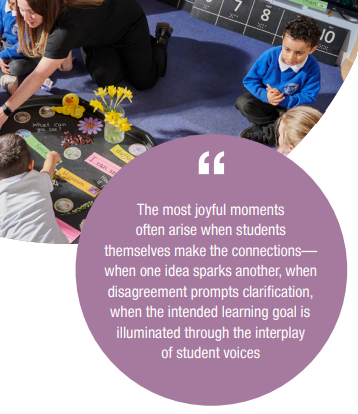
The most joyful moments often arise when students themselves make the connections—when one idea sparks another, when disagreement prompts clarification, when the intended learning goal is illuminated through the interplay of student voices. These moments feel like the crescendo in a piece of music or the punch line in a joke, when the classroom experiences, designed, constructed, and coordinated by the teacher, illuminate the intended
object of learning.
The effective use of oracy to deepen learning in the maths classroom is both an art and a skill — but it is one I have seen brought to life in real classrooms in schools across England. It is a skill that teachers can develop and that they should be empowered to master.
1. Mike Askew, King’s College London. http://mikeaskew.net/page3/page5/files/Privatetalkpublicconverse.pdf
2. Stein, M. K., Engle, R. A., Smith, M. S., & Hughes, E. K. (2008). Orchestrating Productive Mathematical Discussions: Five Practices for Helping Teachers Move Beyond Show and Tell. Mathematical Thinking and Learning, 10(4), 313–340.
3. Mason, J., Burton, L., & Stacey, K. (2010). Thinking Mathematically. Dorchester: Prentice Hall.
© 2024 Voice 21. Voice 21 is a registered charity in England and Wales. Charity number 1152672 | Company no. 08165798