
Amy Gaunt, Director of Strategic Development at Voice 21

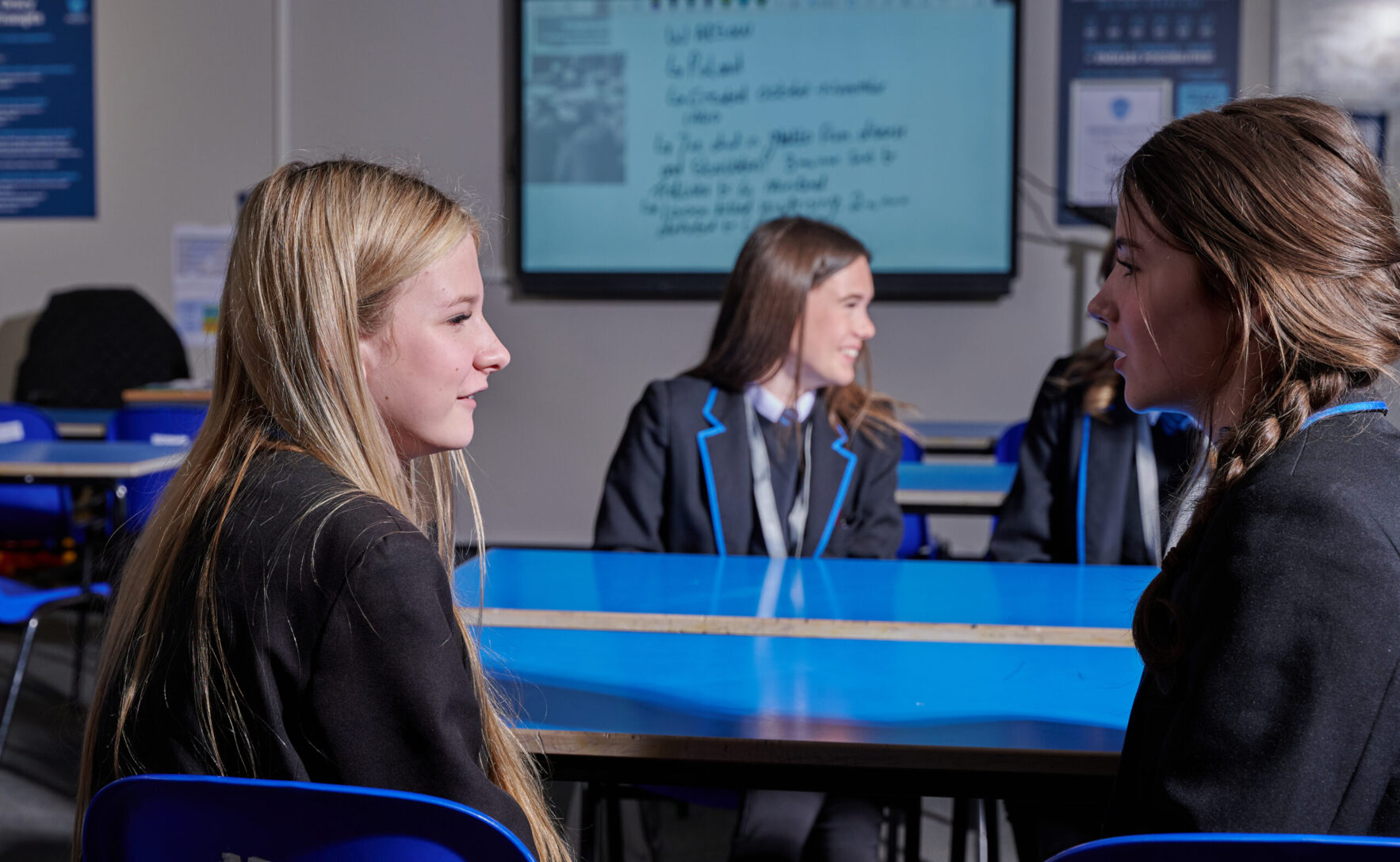
It’s a year 8 geography lesson and there is a lively discussion underway about which of the United Nations’ Sustainable Development Goals should take priority.
“I’ve put quality of education because I reckon if you’ve got pretty good education and all them
children get, like, decent and good jobs, it increases the GDP of the country or the GDP per capita,”
The teacher encourages the student to elaborate on what the impact of this might be in the future before inviting another student to respond.
“Go on Lennon, are we challenging or building?”
Lennon responds. “I’m challenging education. Education is really important and it is high up on my list but I think clean water and zero hunger is more important because without them you won’t be able to live a healthy life. You wouldn’t really be able to go to school if you’ve got diseases”
The teacher nods thoughtfully. “So you’re linking that one and saying, if they’ve not got those things they can’t even go to school. I like that argument.”
The discussion continues. Students use their prior knowledge as well as growing understanding of the Sustainable Development Goals to form reasoned arguments, responding to each other’s points and sharing their emerging thinking. The teacher summarises students’ arguments and encourages them to develop or extend their ideas, using prompts such as: ‘What else could it lead to? Build on that.’
To prepare students to engage in this discussion, the teacher introduced clear expectations.
“You’re going to be telling me and persuading me why you are correct. But other people are going to be challenging you. You might ask someone to clarify. Are you saying that this is more important because…? Or you might build on their idea.”
Throughout the teacher listens intently, occasionally encouraging students to use more precise language to explain their ideas.
“Replace stuff for me.”
“The economy and like what they’ve got,” interjects another student.
Importantly, students are free to share tentative or developing ideas, often pausing and using fillers such as ‘like’ and ‘erm’ as they shape their thoughts. Peers sometimes interject to support or clarify one another’s points, creating a collaborative, supportive environment. The teacher listens closely but avoids correcting students’ use of ‘non-standard English’, recognising that in this context, talk is a tool for thinking. This enables students to explore complex ideas uninterrupted and without worrying about form, fostering richer dialogue and deeper understanding.

Creating dialogic moments like this in the classroom requires skill on the part of the teacher. They must be able to prompt and guide discussion which enables students to explore and develop their ideas whilst furthering the learning goals of their subject. This involves explicitly teaching oracy skills and establishing clear norms for classroom dialogue. Voice 21’s Oracy Benchmarks (2019) provide a useful framework to consider how to do this in practice.
Benchmark 1: Sets high expectations for oracy
Here, setting high expectations for oracy does not mean insisting on the exclusive use of full sentences or standard English. Instead, it reflects the belief that all students, regardless of background or prior attainment, are capable of participating meaningfully in classroom dialogue. In this lesson, high expectations were evident in the decision to dedicate a substantial part of the lesson to student-led discussion. The teacher established clear expectations for this and provided scaffolding, including Voice 21’s Talk Tactics, which equipped students with prompts to engage with one another’s ideas.
Benchmark 2: Values every voice
In this classroom, participation is high, and every student is encouraged to share their thinking,
knowing their contributions will be heard and respected. The teacher listens carefully and supports all learners to extend and refine their ideas. Rather than seeking a single ‘correct’ answer, he is genuinely interested in students’ perspectives and the reasoning behind them. This approach fosters a sense of shared intellectual endeavour, where understanding is built collaboratively. All students are included, and every voice contributes to the learning process.
Benchmark 3: Teaches oracy explicitly
Although the primary aim of the lesson is to develop students’ understanding of the Sustainable Development Goals, it is clear that oracy has been explicitly taught to enable this learning. Students confidently use sentence stems to structure their responses—for example, to challenge, build upon, or clarify a peer’s point—demonstrating familiarity with the features of productive dialogue. Norms such as active listening, taking turns, and engaging respectfully with differing viewpoints have been clearly established through explicit teaching.
Benchmark 4: Harnesses oracy to elevate learning
Oracy is integrated into the lesson as a tool to deepen students’ geographical knowledge and
understanding. Through extended, whole-class discussion, students are supported to make
connections between different Sustainable Development Goals, draw on relevant prior knowledge and articulate cause-and-effect relationships. The teacher’s prompts guide students
to adopt the language and habits of disciplinary thinking. Through talk, students are supported to think geographically.
Benchmark 5: Appraises progress in oracy
Throughout the lesson, the teacher actively appraises students’ use of oracy to monitor both their
geographical understanding and their development as speakers and listeners. By listening carefully to students’ responses and the clarity of their reasoning, the teacher is able to offer in-the-moment feedback, prompting students to elaborate, clarify, or use more precise geographical terminology.
This lesson shows how the Voice 21 Oracy Benchmarks can support teachers to effectively
implement dialogic approaches to teaching and learning. You can find the Oracy Benchmarks here.
© 2024 Voice 21. Voice 21 is a registered charity in England and Wales. Charity number 1152672 | Company no. 08165798